Indriyosense · Kolkata · self test · OK

Intelligent sensing systems for real-world healthcare

We integrate electronic materials, sensor engineering, electronics and intelligent software to create healthcare solutions aimed at earlier diagnosis, continuous monitoring and better patient outcomes.

Without measurement, dosing is an estimate

Plasma levodopa · simulated

1.51µM

L-DOPA oxidation−0.2 Vpotential vs Ag/AgCl+0.6 V
peak height ∝ concentrationIllustrative
WEworkingCEcounterREreference

01 · About

At Indriyosense, we combine cutting edge material science with engineering innovation to develop highly sensitive, reliable, and intelligent systems for healthcare.

Capabilities

Our expertise spans five parallel capabilities:

01 / 05
01 · BIOSENSORSelectrochemical detection in blood & biofluidsL-dopacatechol moiety oxidisesOHOH2e⁻ + 2H⁺direct electron transferWEworkingCEcounterREreferencescreen-printed three-electrode strip · one drop of whole bloodengineered electrode surface — no enzyme layer to degrade

Biosensors

Electrochemical detection of clinically meaningful molecules in blood and biofluids, on engineered electrode surfaces rather than fragile biological catalysts.

MDS 2025 · Applied Physics Letters · ACS Biomaterials Science & Engineering

01 · BIOSENSORSelectrochemical detection in blood & biofluidsL-dopacatechol moiety oxidisesOHOH2e⁻ + 2H⁺direct electron transferWEworkingCEcounterREreferencescreen-printed three-electrode strip · one drop of whole bloodengineered electrode surface — no enzyme layer to degrade

02 · Technology architecture

Every product we build stacks the same five layers:

0102030405

03 · The problem

Parkinson's medication can be difficult to optimise because drug levels change rapidly.

Levodopa concentration changes rapidly, with its blood level decreasing by approximately half within 1–2 hours.

Levodopa monitoring is currently performed through venous blood collection and laboratory-based techniques, resulting in a time-consuming process that is poorly suited to a rapidly changing drug concentration.

Real-time therapeutic drug monitoring is not yet routinely available: although wearables and patient diaries are used to assess symptoms, the actual levodopa concentration associated with those symptoms remains unmeasured.

One dose, over eight hours

Illustrative · not patient data

0%50%100%0 h2 h4 h6 h8 hhalf gone ~1.5 h after peak
Time after dose 5.0 hLevel vs peak 19%

Drag across the chart, or press play, to see how quickly a single dose fades. Shape is schematic.

11.77

million

people living with Parkinson's disease worldwide, 2021

GBD 2021

17.27

million

projected worldwide by 2035

GBD 2021

1–2

hours

plasma half-life of levodopa

Clinical pharmacology

40–50

per cent

develop wearing-off within five years of treatment

Motor complications

04 · The product

MONOTECT

Developing rapid blood levodopa sensing for personalised Parkinson's care.

Investigational device. Under development and not approved for clinical use in any jurisdiction.

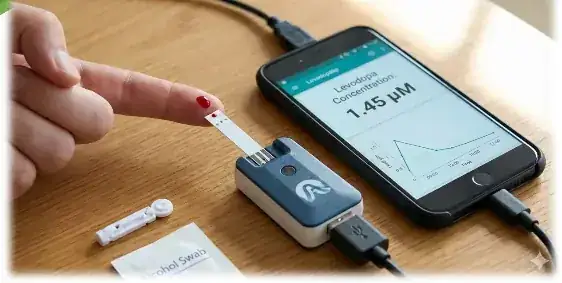
MONOTECT is being developed so that a single drop of blood from a fingertip, on a small disposable strip, can show how much of your Parkinson's medicine is in your bloodstream, in about the time it takes to check a blood sugar reading.

It is a finger-prick sensor being developed to help monitor levodopa levels in Parkinson's patients, with the goal of supporting more informed dosing decisions and a better quality of life. It integrates non-enzymatic electrochemical sensing technology with innovative functional materials and intelligent data analytics, and is engineered to deliver rapid measurements in support of personalized disease management. Analytical performance is under evaluation.

Once validated, it is intended to assist clinicians in monitoring disease progression, evaluating therapeutic response and optimizing treatment strategies through timely and actionable insights. It is portable and user-friendly, designed for point-of-care and remote healthcare applications with the aim of reducing the need for frequent hospital visits and improving patient convenience and quality of life.

A finger-prick test in progress: a sensor strip is inserted into a small reader plugged into a smartphone, which displays a levodopa concentration reading.
Strip, reader and smartphone at the point of care.

Screen- and inkjet-printed three-electrode strips on flexible substrates.

05 · Research & Recognition

MDS 2025 International Congress · Technology

Electrochemical Sensing for Accurate L-Dopa Detection in Parkinson's Disease

P. Dutta · A. Eshore · P. Guha · M. Acharya

  • Portable electrochemical sensor with nanomaterial-based electrodes
  • Characterised by cyclic voltammetry and differential pulse voltammetry
  • Reported limit of detection of 10 nM
  • Positioned as a point-of-care alternative to HPLC

Read the abstract →

06 · Team

Team

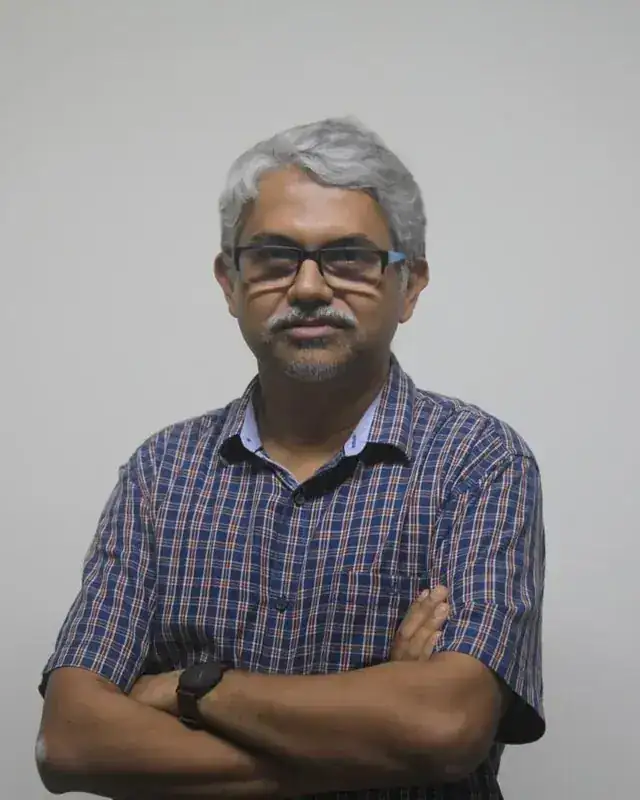
Portrait of Abhijit Narayan Eshore.

Abhijit Narayan Eshore

Co-founder & Director · Research Scientist, IIT Kharagpur

A PhD from IIT Kharagpur, with expertise spanning advanced electronics materials, sensing technologies, interfacing electronics, circuit design, embedded machine learning and IoT/BLE. He has authored peer-reviewed publications and patents in next-generation sensing.

Advanced electronics materialsInterfacing electronicsEmbedded MLIoT / BLE
Selected work: Abhijit Narayan Eshore

Crystallographic nanojunctions of bismuth ferrite for unconventional detection of carbon monoxide. ACS Applied Nano Materials, 2023

A selective resistive CO gas sensor based on bio-waste derived 2D-CaO nanoplates. Nanoscale, 2026

Electrochemical spectroscopy: a novel technique for trace-level glucose detection. IEEE Sensors Letters, 2024, with Prof. Ioannis Kymissis, Columbia University

Portrait of Priyanka Dutta.

Priyanka Dutta

Co-founder & Director · Senior Research Fellow, IIT Kharagpur

Specialising in state-of-the-art fabrication and device-integration techniques, prototype validation and innovative engineering for healthcare, working towards precision diagnostics that are affordable and reach patients.

FabricationPrototype validationDevice integrationBiosensors
Selected work: Priyanka Dutta

Fully screen-printed flexible electrochemical sensor based on Ti₃C₂Tₓ–CuO nanocomposite for simultaneous determination of dopamine and uric acid. IEEE Sensors Journal, 2026

A direct MIP-interfaced FET sensor for sensitive, selective and real-time biomolecule detection in unamplified samples. Applied Physics Letters, 2023

Molecularly imprinted polymer interface on screen-printed ZnO nanorod field effect transistors for serotonin detection in clinical samples. ACS Biomaterials Science & Engineering, 2023

Portrait of Prof. Prasanta Kumar Guha.

Prof. Prasanta Kumar Guha

Co-founder & Advisor · E&ECE Department, IIT Kharagpur

A Professor at IIT Kharagpur with expertise in material science, advanced electronics, semiconductor physics and related models, device fabrication and sensing technologies. He provides strategic guidance on research and technology development, product innovation and scientific direction.

4,711citations
36h-index
83i10-index

Google Scholar, August 2026

MPhil and PhD, University of Cambridge · Research Associate, University of Warwick · IIT Kharagpur since 2010 · In-charge, VLSI Engineering Lab

Selected work: Prof. Prasanta Kumar Guha

Smart and selective gas sensor system empowered with machine learning over IoT platform. IEEE Internet of Things Journal, 2023

Hierarchical nanostructured WO₃–SnO₂ for selective sensing of volatile organic compounds. Nanoscale, 2015 · 255 citations

Selective discrimination of VOCs applying gas sensing kinetic analysis over a metal oxide-based chemiresistive gas sensor. ACS Sensors, 2021 · 184 citations

07 · Contact

We are looking for the right first partners.

We are talking to movement-disorder clinicians who want to pilot the device, engineers who want to build sensors that reach patients, and partners who share the goal. If you are one of them, write to us.

We use your details only to reply to you. No mailing list, no third-party marketing. See contact & data use.